Huberman Lab transcripts
Neuroscientist Andrew Huberman on science and science-based tools for health and performance. Each transcript comes with an AI summary, key points and chapters, and plays the episode from any word you click.
-
 Unlocking Persistent Motivation & Extreme Resilience | Ross Edgley
Andrew Huberman talks with ultra-endurance swimmer Ross Edgley about the psychology and neuroscience of motivation and resilience, drawing on his long-distance swims around Great Britain, Iceland, and the Yukon River. They frame motivation as a balance of many drivers, including self-respect, love for family, defiance of doubters, and inner purpose, and discuss the anterior midcingulate cortex, prefrontal strategy-setting, and stress inoculation as ways to build persistence. The conversation closes with the Sisyphus myth and Edgley's view that the struggle itself can fulfill a person.
-
 Essentials: Developing a Rational Approach to Supplementation for Health & Performance
Andrew Huberman argues that supplements should be considered only after behavioral tools (like morning sunlight and exercise) and nutrition, and that they work best within that larger context. He offers a framework for choosing supplements: foundational multi-ingredient products for baseline coverage, and single-ingredient trials for targeted goals like sleep, hormones, and focus. He repeatedly stresses consulting a physician before changing any protocol.
-
 What Makes Great Leaders & How to Live an Extraordinary Life | Dr. Jared Diamond
Dr. Jared Diamond, discussing his book Prophets, Coaches, and Kings, argues that there is no single personality type that makes a great leader; charisma is just one of about 37 ways to be effective, and leadership outcomes depend heavily on circumstances, followers, and luck. He uses natural-experiment methods to examine leaders in politics, religion, business, and sport, and reflects on his own varied career and the value of pursuing what you enjoy.
-
 Essentials: Neuralink & Technologies to Enhance Human Brains | Dr. Matt MacDougall
Neurosurgeon and Neuralink team member Dr. Matthew MacDougall discusses brain-machine interfaces, focusing first on restoring digital control for people with paralysis from spinal cord injuries. He explains the robotic electrode insertion, animal safety testing in pigs and monkeys, and his longer-term vision of expanded cognition, while stressing the near-term goal is reducing human suffering.
-
 How Food Choices Shape Memory, Cognition & Cravings | Dr. Scott Kanoski
Dr. Scott Kanoski, a USC neurobiologist, explains how GLP-1 hormones and drugs suppress appetite via gut-to-brain vagal signaling, and how diet, including sugar, artificial sweeteners, and heat-processed foods, can affect hippocampal memory in animal models, sometimes via the gut microbiome. He stresses that most evidence is preclinical, that human data are limited, and that a healthy, nutrient-dense diet, exercise, and gut health are the best-supported ways to protect brain function.
-
 Essentials: Manage Stress & Build Resilience | Dr. Elissa Epel
Dr. Elissa Epel, a stress scientist, explains that stress itself is not the main problem; how we respond and recover matters most, and chronic rumination is a key driver of harm. She outlines tools for managing overthinking and reframing stress as a challenge, and links chronic stress to mitochondrial health, daily mood, and accelerated aging, concluding that acceptance, letting go of unsolvable problems, and meaningful narrative help build resilience.
-
 Bringing Extinct Species Back to Life | Dr. Beth Shapiro
Dr. Beth Shapiro, chief scientific officer at Colossal Biosciences, explains how ancient DNA lets scientists study and attempt to bring back extinct species such as the woolly mammoth, dodo, thylacine, and direwolf. She argues that the same tools used for de-extinction can help save living endangered species, and that doing nothing is also a choice with consequences. The episode also covers species concepts, Neanderthal ancestry, and the ethics of genetic engineering in animals and humans.
-
 Tools to Improve Your Focus & Concentration | Huberman Lab Essentials
Andrew Huberman presents science-based tools for improving focus and concentration, framed around a model of epinephrine (alertness), acetylcholine (spotlight of focus), and dopamine (motivation). He covers sleep, white or pink noise, 90-minute ultradian work cycles, fasting versus eating, caffeine timing, cold exposure, a 13-minute daily meditation, visual focus practice, and supplements like omega-3s, creatine, alpha GPC, and L-tyrosine. His main conclusion is that behavioral tools should come first, with supplements as a route to deeper focus and prescription stimulants reserved for clinical ADHD under medical supervision.
-
 What Humans, Animals and Plants Tell Us About Consciousness | Michael Pollan
Andrew Huberman interviews science writer Michael Pollan about his book A World Appears and the science and philosophy of consciousness. They explore how even plants and bacteria show sensience, how the ego and self can dissolve through psychedelics, meditation, and awe, and how consciousness may remain unexplained by brain matter alone. The conversation also covers psychedelic medicine's movement toward FDA approval and the food system's health problems.
-
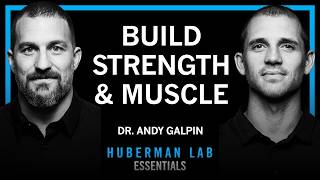 Essentials: Optimal Protocols to Build Strength & Grow Muscles | Dr. Andy Galpin
Dr. Andy Galpin explains why strength and hypertrophy training matters for everyone, not just athletes or bodybuilders, since strength and muscle power decline faster with age than muscle mass and resistance training is the main tool against neuromuscular aging. He lays out core principles (consistency, progressive overload, individualization, specificity vs. variation) and practical protocols, including the 3-to-5 method for strength and power and volume and frequency guidelines for hypertrophy.